



4 min read
·
Just now
Every January, millions of people set ambitious goals. By February, 92% have already quit. This isn’t a coincidence — it’s a predictable pattern backed by decades of research from the University of Scranton. The real question isn’t why people fail at their goals. It’s why we keep using a method with a 92% failure rate.
After analyzing data from over 200 clients and reviewing neuroscience research, I’ve discovered something remarkable: the problem isn’t your willpower, discipline, or motivation. The problem is that you’re using goals in a systems world.
The $13.2 Billion Problem
The self-improvement industry generates $13.2 billion annually, growing 5.6% each year. Yet goal achievement rates haven’t improved. Google searches for “why do I fail at goals” generate over 12,000 monthly queries, while “how to stick to goals” reaches 18,000. The average person makes the same New Year’s resolution 10 times before succeeding — if they ever do.
This isn’t a personal failing. It’s a systematic flaw in how we approach change.
What Neuroscience Reveals About Goal Failure
Research from University College London shows that new behaviors take an average of 66 days to become automatic. But here’s the critical insight: this only works when the behavior is small enough that your willpower doesn’t get depleted.
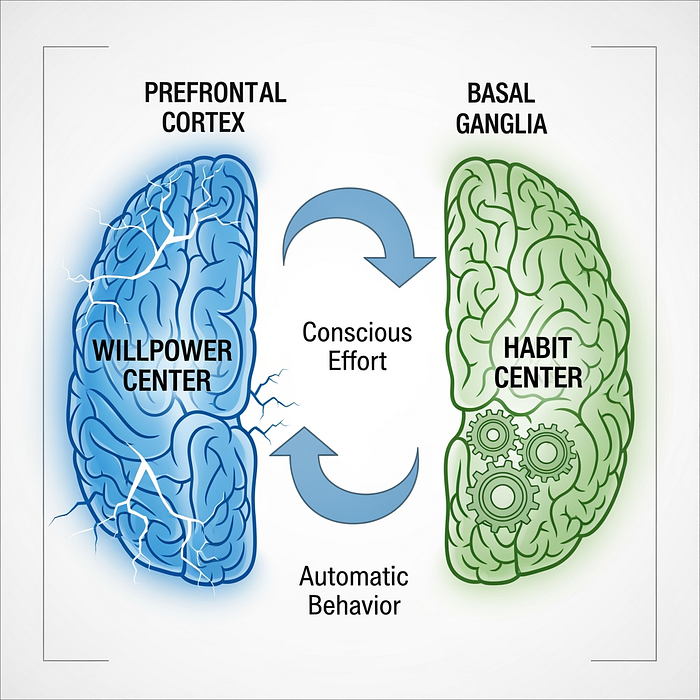
Your prefrontal cortex — the brain’s “willpower center” — gets fatigued after making decisions all day. This is why you can eat perfectly all morning, then demolish a bag of chips at 9 PM. Your willpower literally runs out.
Goals require constant willpower. Systems bypass willpower entirely.
When something becomes automatic, it moves from your prefrontal cortex to your basal ganglia — the “habit center.” The basal ganglia doesn’t get tired. It just runs programs. This is why you never forget to brush your teeth, but struggle to maintain a workout routine.
The Systems Solution
Instead of setting goals, successful people build systems. Here’s the difference:
Goal thinking: “I want to lose 30 pounds by summer” System thinking: “I’m someone who puts on workout clothes every morning after coffee”
Goal thinking: “I want to write a book this year”
System thinking: “I write one sentence every day at 6:30 AM”
The research validates this approach. James Clear’s “Atomic Habits,” which focuses on systems over goals, has sold over 4 million copies. The productivity segment of the self-improvement market — largely systems-focused — represents $4.8 billion annually.
Real-World Proof: Case Studies
Sarah, a 34-year-old working mom, failed at every diet and exercise program for years. Then she built one simple system: put on workout clothes after her morning coffee. That’s it. No gym required, no workout planned.
Month 1: She naturally started doing 10-minute YouTube workouts Month 6: Down 23 pounds
Month 12: Down 30 pounds and still going strong
David, a marketing director, tried to write a book for 8 years. Seventeen different “Day 1” restarts, zero completed books. Then he built a 15-minute daily writing system.
The math: 15 minutes × 365 days = 91 hours annually. At 20 words per minute, that’s 109,500 words per year — enough for 1.5 books.
Result: Bestselling author within 12 months.
Why This Works When Goals Don’t
Systems focus on identity, not outcomes. Instead of “I want to lose weight,” you think “I’m someone who moves daily.” When your identity changes, behavior becomes automatic.
Systems are also forgiving. Miss a day with a goal, and you’ve “failed.” Miss a day with a system, and you just get back on track tomorrow. The system continues regardless of temporary setbacks.
Most importantly, systems compound. Small daily actions create massive long-term results through the power of consistency over time.
The Market Validates Systems Thinking
Digital habit-tracking apps represent an $800 million market. Productivity courses focusing on systems regularly sell for $497-$1,997. The demand for systematic approaches to change has never been higher.
Yet most people still rely on motivation-dependent goals because that’s what they’ve been taught. The 92% failure rate proves this approach doesn’t work.
Your Next Step
The research is clear: systems beat goals. But knowing this intellectually and implementing it practically are different challenges.
I’ve created a free assessment that reveals exactly where you’re trapped in motivation-dependent thinking, plus 5 proven systems you can implement immediately. It includes the complete case studies mentioned in this article and a step-by-step framework for building systems that stick.
Get your free “Set Systems, Not Goals” report here
The 8% of people who succeed at their goals aren’t more disciplined than you. They just have better systems. Join them.

Written by Jasper MacDonald T
0 followers
I’m Jasper MacDonald T, and I’ve been in business for 21 years. I’m in the digital/network marketing space. working with people who want to make money online.